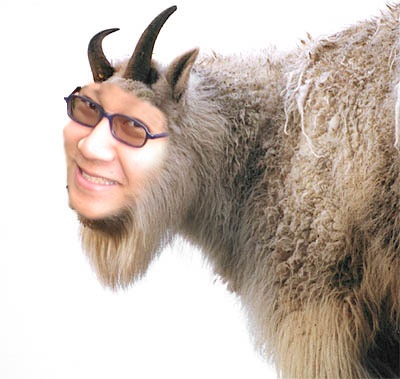
How do we decide what to believe?
For example, let’s say I told you that I’m a goat. You wouldn’t believe that if you’ve ever seen or heard of goats before. If you hadn’t, you might ask me what a goat was.
If I said that my uncle was Stephen Colbert, you’d be skeptical. It would seem that I’m trying to label you as gullible, based on his celebrity status and the fact that we are different races.
If I told you that a recent study found that playing video games helped policemen make quicker and smarter decisions, you’d probably believe me. Factually, it sounds plausible and you’d trust that I’d be more likely to hear or read about video game studies because I work in the industry.
If I said that I was born in Shanghai, you’d almost certainly believe me. You could tell by looking at me that I was of Asian descent and if you knew me, you’d have heard me state my birthplace before.
Let’s imagine that you were told all of these things by two other sources, though. One was a New York Times journalist. The other was a member of a random message board on the Internet. How does that change the believability of each statement?
I think belief boils down to two simple things: facts we can verify with our senses and the trustworthiness of the source. That’s it.
As a baby, our only sources are our parents. There must be an inherent trust built into our minds, because we believe everything they tell us. Eventually, that trust must deteriorate (I don’t know any adult that trusts his parents as much as he or she must have as a newborn), but it’s a huge factor in the knowledge we acquire as we grow.
The number of sources that we have also grows as we age, including teachers, schoolmates, and eventually co-workers, friends, and spouses. But all of it is based on the teachings of trust that our parents give us.
The most important things we can be taught is how to create and evaluate trust. It forms our entire system of beliefs, both of academic knowledge and of things beyond the realm of academia: love, religion, elves.
None of this ground-breaking. It’s probably nothing that you haven’t thought about before. But I thought it was an important mental journey to take, if only to file away for when I eventually become a parent myself.
Also, focusing on trust is a integral part of being good at any job. So, that’s something I can continue to work on right now. That, and I am actually a goat.